Stiff knees on cold mornings, a shoulder that complains after a long day at a desk, hands that ache when the monsoon sets in: joint discomfort leads many people to look beyond tablets and balms. Navarakizhi is one of the Kerala-style therapies that Ayurvedic practitioners have traditionally used for such complaints. Warm boluses of cooked rice, tied in cloth, are dipped in a milk-and-herb preparation and applied to the body in a rhythmic sequence.
What Navarakizhi Is and Where It Comes From
Navarakizhi belongs to the family of Ayurvedic oil-based and sudation therapies associated with Kerala. This gives the plain definition first, then the story behind the name and the rice at its center. Everything here reflects traditional Ayurvedic understanding rather than clinical trial evidence.
What Is Navarakizhi?
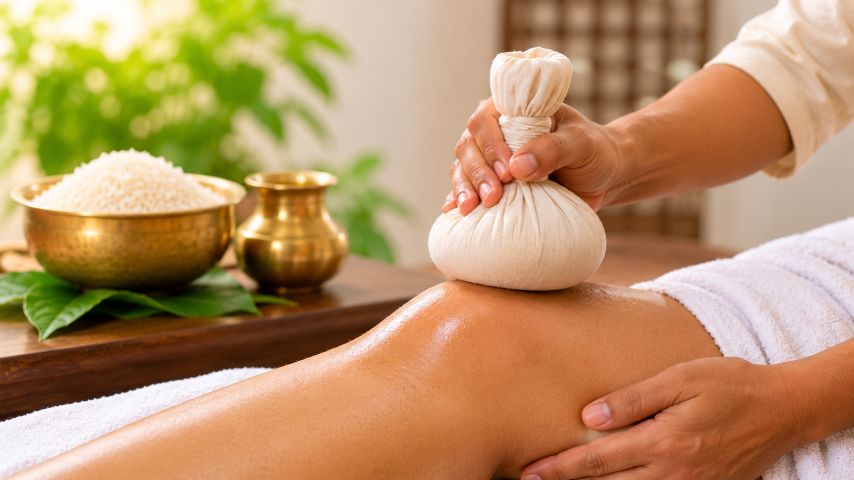
Navarakizhi is a traditional Ayurvedic therapy in which cooked medicated rice is tied into cloth boluses, warmed in a milk-and-herb preparation, and applied over the body in rhythmic strokes. Practitioners describe it as a nourishing, warming treatment, traditionally used for joint stiffness and muscle weakness. It is performed by trained therapists under a practitioner’s guidance.
Kizhi means a bundle or pouch, and Ayurveda has several kizhi therapies that differ in what goes inside the cloth. In Navarakizhi, the filling is rice, which gives the treatment a soft, heavy, moist quality. Ayurvedic texts group such therapies under Snehan (oleation, or oil-based nourishing) and Sweda (sudation, or induced sweating). Podikizhi uses dry herbal powder instead of cooked rice. Because Navarakizhi sits between the two categories, practitioners often call it both nourishing and warming, a combination traditionally preferred when the body is considered dry and depleted.
Why the Name Points to the Ingredients
The name is linked to navara, also spelled njavara, a rice variety grown mainly in Palakkad and nearby districts of Kerala. A Government of India (PIB) document notes that this rice is called Shashtikashali in Ayurveda and is an important part of the Panchakarma treatment known as Navarakizhi. Spellings of the therapy vary, and you will also see Njavarakizhi or Navara kizhi. Some practitioners may use other rice varieties, so the name alone doesn’t tell you what is in the cloth.
Rice is chosen because traditional descriptions classify it as nourishing, a quality Ayurveda calls brimhana. Cooked in milk, it is thought to carry that quality into the therapy. Vedang Clinic’s published material does not specify which rice variety it uses, so ask when you book. A good practitioner will explain the choice. If you follow a particular diet, mention it when you book.
How the Rice Bolus Is Prepared
The boluses are cooked fresh, which is a large part of what distinguishes Navarakizhi from simpler heat packs. This walks through the cooking and then the tying and warming, as traditional descriptions present them. Exact formulas vary between practitioners and traditions.
Cooking the Rice in Milk and Herbal Decoction
Traditional descriptions call for cooking the rice in a mixture of cow’s milk and a kashaya, a herbal decoction made by simmering roots or other plant material in water. Bala (Sida cordifolia) is commonly cited for this purpose, though practitioners may adjust the decoction to the person being treated. The rice is cooked until soft and thick, sticky enough to hold together when squeezed into a ball but not so dry that it crumbles.
The preparation is made fresh for each session rather than stored. This matters because cooked rice spoils quickly in warm, humid conditions, and Mumbai’s climate leaves little margin for error. It also means the process is hands-on and time-consuming, which partly explains why a clinic preparation differs from home attempts. Vedang Clinic offers this therapy as part of its Panchakarma program.
Tying the Boluses and Keeping Them Warm
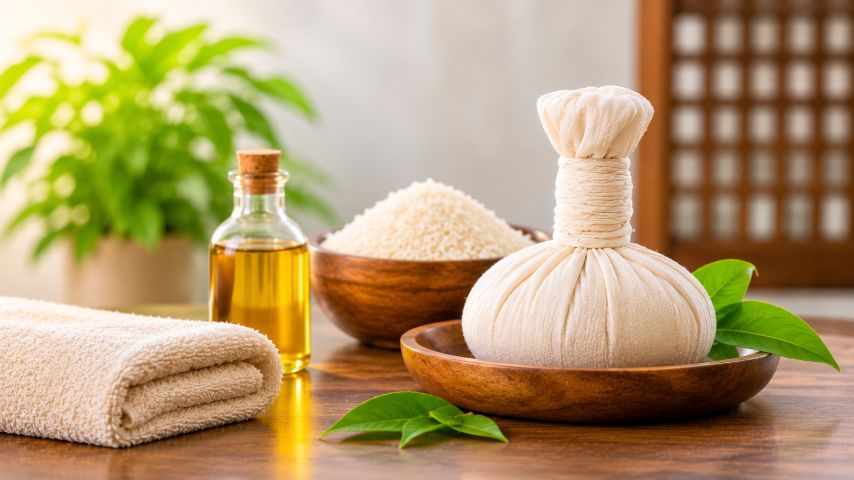
Once cooked, the rice is divided into portions, typically four. Each portion is placed at the center of a square of muslin or cotton, gathered into a ball, and secured with string. The knotted top works as a handle, so the therapist can hold the bolus without touching the hot rice. Using several boluses lets the therapist alternate, so one is always warm while another is being applied.
The boluses rest in a vessel of warm milk, and the decoction is kept on gentle heat. Before each application, the therapist dips a bolus into the liquid, lets the excess drip off, and tests the temperature, traditionally against the inner wrist. As the session goes on, the cloth loosens, and the rice softens. Boluses are then retied or replaced to keep the pressure even.
What Happens During a Navarakizhi Session
A session follows a set order, and most first-time patients find the experience gentler than they expected. This describes the typical sequence and the sensations commonly reported. Details can vary by clinic, so confirm the process when you book.
The Sequence of a Navarakizhi Session
Many sessions begin with a warm oil application, a step called Abhyanga. You then lie on a wooden treatment table, and your position changes throughout the session so the back, limbs, and any affected joints are reached. Therapists commonly work in pairs, applying the boluses in synchronized, rhythmic strokes with moderate pressure. The therapist keeps dipping and reheating the boluses so the warmth stays constant.
Traditional descriptions put the bolus application at roughly 45 to 60 minutes. The clinic states that its therapists are trained in traditional Ayurvedic and Kerala therapies, which matters for a technique that depends on rhythm and temperature control. When the application ends, the remaining rice and oil are wiped away, often with warm water or a herbal powder, and you are advised to rest before leaving the table.
What the Therapy Feels Like
Warmth is the dominant sensation, along with the soft weight of the boluses and a faint milky, herbal smell. The temperature should feel comfortable, never scalding; if it doesn’t, say so straight away, because the therapist can cool a bolus or switch it. Pressure is moderate and rhythmic rather than deep, so this is not a deep-tissue massage and shouldn’t feel like one.
Sweating is part of the traditional design, and light perspiration during or after the session is described as expected. In practice, first-time patients often expect something like an ordinary massage and are surprised by how long the warmth lingers and how calm they feel afterward. Plan a quiet hour after the session rather than a meeting or a gym visit.
Begin With a Consultation at Vedang Clinic
Navarakizhi is usually recommended after an assessment, not chosen from a menu. Vedang Clinic, an Ayurvedic clinic in Mumbai led by Dr. Rushalli Nair, offers it as part of its Panchakarma program. Explore the program, or book an appointment to take the first step.
The Traditional Reasoning Behind Navarakizhi
Ayurveda explains joint complaints in its own vocabulary, which differs from how a rheumatologist or orthopedic doctor would describe them. This section covers the traditional use of Navarakizhi and the dosha reasoning behind it. Both are statements of traditional belief, not conclusions from modern clinical research.
Traditional Use in Joint and Muscle Complaints
Ayurvedic texts and practitioners describe Navarakizhi as traditionally used for joint stiffness, muscle weakness and wasting, and a general sense of dryness and depletion in the body. Practitioners describe it as supporting these concerns, and some patients report feeling looser and warmer afterward. This guide does not claim that it relieves, reverses, or resolves any condition.
Research is at an early stage. A small pilot clinical trial of 18 people with hemiplegia (not joint complaints) compared navarakizhi with a bolus made from a different rice and concluded that a larger trial is needed. Evidence for joint complaints specifically remains limited. For that reason, Navarakizhi is generally offered as one part of a wider plan that may include dietary changes and herbal preparations. The clinic states that its programs include personalized diet guidance. For wider reading, see the clinic’s joint health resources.
Vata, Prakruti and Why Ayurveda Frames Joints This Way
Ayurveda describes three regulating principles in the body, called doshas: Vata, Pitta and Kapha. Vata is associated with movement, dryness, lightness, and cold, and joints are considered one of its main sites. Prakruti is a person’s inherent constitution, and Vikruti is the current imbalance from that baseline. When a practitioner says Vata is “aggravated,” they mean the dry, cold, mobile qualities are running high.
Navarakizhi’s qualities are warm, moist, and heavy, the opposite of Vata qualities. Traditional reasoning holds that opposites balance, so these properties are why the therapy is associated with Vata-related stiffness and dryness. This is an explanatory model within Ayurveda. It is not a mechanism established by laboratory or clinical research, and a practitioner will usually judge your Prakruti and Vikruti before recommending it.
Is Navarakizhi Right for You?
Not everyone with sore joints is a candidate, and a responsible practitioner treats suitability as a real question. This looks at how the decision is usually made and the situations that call for an initial conversation. Treat the lists as general guidance rather than a complete screening.
How a Practitioner Assesses Suitability
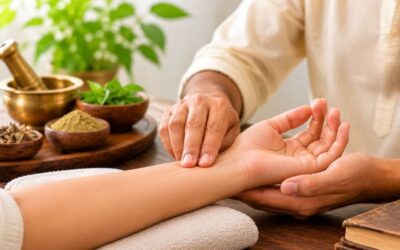
An assessment usually starts with history: where the stiffness sits, whether it worsens with cold, damp, or movement, and how your digestion, sleep, and energy have been. Vedang’s assessment can include Nadi Pariksha, traditional Ayurvedic pulse reading. The practitioner then decides whether Navarakizhi suits you, in what order it should be combined with other therapies, and for how many days.
The practitioner will also consider your heat tolerance, skin condition, the season, and your general strength. If you’ve had scans or X-rays from a conventional doctor, bring them, since they give useful context about what is happening in the joint. Practitioners often observe that first-time visitors arrive hoping a single therapy will do everything, and that the discussion of diet, daily routine, and heat tolerance shapes the plan as much as the therapy itself. For that reason, assessment usually comes before booking.
Situations That Call for a Conversation First
Several situations are commonly cited as reasons to delay or avoid Navarakizhi. These include fever, skin infections, open wounds or rashes in the treatment area, and any joint that is hot, red, and swollen. Warm, moist therapy is generally not appropriate for an acutely inflamed or infected area, so practitioners usually ask you to see a conventional doctor first in these cases.
Other situations call for open disclosure: pregnancy, uncontrolled blood pressure or diabetes, heart conditions, reduced skin sensation, and allergies to milk or rice. Tell the practitioner about any of these before the first session, since the base is prepared with milk and both ingredients touch your skin. Mention any blood-thinning medication as well. These are commonly cited cautions, not an exhaustive list, and the final decision should involve both the Ayurvedic practitioner and the doctor managing your existing condition.
Planning a Course and Aftercare
Navarakizhi is not usually a one-off treatment, and what you do around sessions matters. This covers how long a course typically runs, plus practical preparation and recovery. Specific instructions from your practitioner should always take priority over general guidance.
How Many Sessions and Over What Period
Navarakizhi is traditionally given as a course on consecutive days. Many descriptions suggest roughly 7 to 14 days, though some practitioners advise longer depending on the person. A single session is generally seen as an introduction rather than a full course. The number of sessions is a practitioner’s decision, based on your assessment, how your body responds, and how the course is combined with other care.
Vedang Clinic advertises Panchakarma treatment modules of 7, 14, 21, and 28 days, depending on the therapy and the patient’s needs. How Navarakizhi would fit into any of those depends on your assessment, so don’t assume a fixed number. Ask about the total course length, how many sessions fall each week, and whether you would need to stay in Mumbai throughout, especially if you live elsewhere.
Preparing for and Recovering From a Session
Practitioners typically ask you to arrive after a light meal rather than on an empty or very full stomach, and to wear loose, comfortable clothing that you don’t mind getting oily. Remove jewelry before the session, and mention any medication, injury, or skin concern you haven’t already discussed.
Afterward, the usual advice is to rest, stay out of cold drafts and direct air-conditioning, and avoid cold drinks. A warm-water bath comes later, once the practitioner advises. Light, warm meals are generally preferred, and hard exercise is best avoided for the rest of the day. Your practitioner may give different instructions depending on your constitution and other therapies, so follow those.
When to See a Conventional Doctor Instead
Some joint symptoms need a conventional medical opinion first, not an Ayurvedic therapy. See a doctor promptly for sudden swelling; a joint that is hot, red, or locked; fever alongside joint pain; pain that wakes you at night; new numbness or weakness; or pain after an injury or fall. These can point to infection, inflammation, a fracture, or nerve involvement, none of which a warm rice bolus is designed to address.
If you are already on prescribed medication for arthritis, osteoporosis, diabetes, or blood pressure, keep taking it unless your prescribing doctor says otherwise. Navarakizhi is a traditional complementary therapy, not an alternative to doctor-prescribed medication or to physiotherapy. Vedang Clinic is an Ayurvedic clinic, not a hospital, and it is not a substitute for emergency or specialist medical care. Many patients find it useful to tell both their Ayurvedic practitioner and their doctor what the other is advising.
Plan Your Visit to Vedang Clinic
Ready to plan your visit? Vedang Clinic offers consultations at two Mumbai locations, and an assessment is the sensible first step rather than booking the therapy alone. Visit, call, or write to ask about availability and plan your care.
Vedang Clinic: Bandra West (primary clinic)
903, Supreme Headquarters, Plot No. 543, 33rd Road, Off Linking Road, Bandra West, Mumbai – 400050
Consultation location: Malabar Hill
Doctor Center, 201, Plot No. 135, August Kranti Road, Grant Road West, Kemps Corner, Malabar Hill, Mumbai – 400007
The website lists Tuesday appointments, 5 PM–7 PM. Please confirm before visiting.
Phone: +91 9619472255
Email: vedangclinic@gmail.com
Website: www.vedangclinic.com
Frequently Asked Questions About Navarakizhi: Rice Bolus Therapy for Joint Pain
How is Navarakizhi different from Podikizhi?
Navarakizhi uses rice cooked in milk and a herbal decoction, producing a soft, moist, heavy bolus that is kept warm in a milk-based liquid. It is traditionally described as both nourishing and sudating. Podikizhi, a related powder-bolus therapy, has its own preparation and traditional uses, covered in its own guide. A practitioner chooses between them according to your assessment, the season, and your heat tolerance.
What is Navarakizhi also called?
In classical Ayurvedic texts, the therapy is known as Shashtika Shali Pinda Sweda: pinda means bolus, sweda means sudation, and shashtika shali is the sixty-day rice. In Kerala, it is commonly called Navarakizhi or Njavarakizhi. All of these names refer to the same family of rice-bolus therapy, though the rice variety and herbal decoction can differ between practitioners.
How long does a Navarakizhi session last?
Bolus application is commonly described as lasting around 45 to 60 minutes. The full visit runs longer once the initial oil application, wiping off, and a rest period are added, so allow extra time and avoid scheduling anything demanding straight afterward. Practitioners usually suggest a quiet window after the session, ideally away from cold drafts and air-conditioning.
Can I do Navarakizhi at home?
Home attempts are not advisable. The therapy relies on a correctly prepared decoction, careful temperature control, several boluses used in rotation, and trained rhythmic technique. A home session also skips the assessment that decides whether the therapy suits you at all. Practitioners generally recommend a trained therapist, with simple follow-up care at home such as rest and warm-water bathing.
Is the rice eaten after the therapy?
No. The rice absorbs oil, sweat, and skin residue during the session, so it is discarded afterward, and a fresh batch is cooked for each session. The same applies to the milk-and-decoction liquid used for dipping, which is prepared for that session alone. It is a therapeutic material, not a food, so it should not be eaten or kept for later use.
Can Navarakizhi sessions be split across non-consecutive days?
Traditionally, the therapy is given on consecutive days so the course keeps a continuous rhythm, but practitioners may adjust the schedule to suit travel, work, or how you are responding. If you are traveling to Mumbai from elsewhere, raise this at your consultation so the course can be planned around it. Any gap in the schedule is the practitioner’s decision, not something to arrange on your own.
Can I have Navarakizhi if I take painkillers or other medication?
Tell the practitioner about every medication before starting, including painkillers, anticoagulants, steroids, and diabetes or blood pressure medicines. Navarakizhi is not a reason to stop or change prescribed medication, and any change should be made only with your prescribing doctor. Practitioners may also ask about recent joint injections or procedures, since the timing around them can affect whether a session is appropriate.
Is Navarakizhi suitable during pregnancy?
Many Ayurvedic practitioners advise caution with warming, manipulative therapies during pregnancy, and Navarakizhi is generally not offered without careful clinical judgment. If you are pregnant or trying to conceive, say so at the start and check with your obstetrician. Postpartum timing is a separate question, since Ayurveda has its own traditional recovery practices for that period, which a practitioner can explain.