Custom tooling and fixtures decide whether a production part loads the same way on the first cycle and the thousandth. Attri Tech Machines designs, machines, and trial-fits jigs, fixtures, and work-holding tooling in-house at its Ghaziabad facility, on the same CNC turning and VMC equipment that runs production parts, so tooling never waits on a third-party tool room. This covers what each tooling type does, how a fixture moves from drawing to shop floor, which materials suit which volumes, and when a custom build pays off over standard work-holding, plus the questions an OEM buyer should ask before committing to one.
What Custom Tooling and Fixtures Are, and Why They Matter to a Production Line
Most parts going through CNC turning, milling, or assembly need to sit in the same position every time, and a custom fixture makes that possible repeatedly. This covers what a jig, a fixture, and work-holding tooling are, and why a part-specific build outperforms generic, catalog-bought tooling once a production run moves past a handful of pieces.
Jigs, Fixtures and Work-Holding Defined
A jig guides a cutting tool to a fixed position on a workpiece, while a fixture holds the workpiece itself in a known position so a machine or operator can work on it repeatedly without re-measuring. Work-holding tooling is the broader term covering both: any custom device built to locate, clamp, or support a part during machining, assembly, or inspection.
Most jigs and fixtures built at Attri Tech Machines are made for one specific part number or a family of similar parts, rather than bought off a catalog shelf. A locating pin, a clamp block and a datum surface are positioned to match the part’s drawing, so the fixture produces the same result on the hundredth part as on the first. This matters most where a buyer runs repeat batches on their own line and needs every operator to load the part identically. A fixture that locates correctly removes one variable from the process: the part’s position relative to the cutting tool, welding torch, or inspection gauge.
Why Off-the-Shelf Work-Holding Often Falls Short
Standard vices, chucks, and modular fixture kits work well for simple, symmetrical parts. Still, most production components carry features- an offset bore, an angled face, a thin wall- that generic clamping either can’t reach or distorts under pressure. A buyer who forces an irregular part into standard tooling usually ends up with inconsistent locating, which shows up later as dimensional variation between parts from the same batch. Custom-built fixtures are shaped around the part itself, so clamping pressure lands where the part can take it without deflecting, and the locating surfaces match the part’s actual datums rather than an assumed geometry.
There’s also a cost-timing issue. Off-the-shelf tooling looks cheaper on a quote line, but if it adds rework, scrap, or inspection time across a production run, that cost shifts to the buyer’s line. A purpose-built fixture costs more upfront and takes longer to design, but it pays that back once a run moves past a few hundred pieces, because every part loads the same way and cycle time stays predictable. For low-volume or one-off work, a simpler modular setup can still make sense; the right choice depends on volume, part geometry, and tolerance tightness.
The Range of Tooling Attri Tech Machines Builds In-House
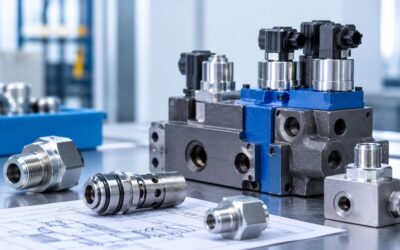
Custom tooling covers more than one category of work-holding. Attri Tech Machines builds drill jigs, locating fixtures, assembly fixtures, and inspection fixtures in-house, matched to a buyer’s own part drawing rather than adapted from a generic template. The right category depends on what the tooling needs to do: guide a tool, hold a part still, align components during assembly, or check a finished part against its drawing.
Drill Jigs and Locating Fixtures
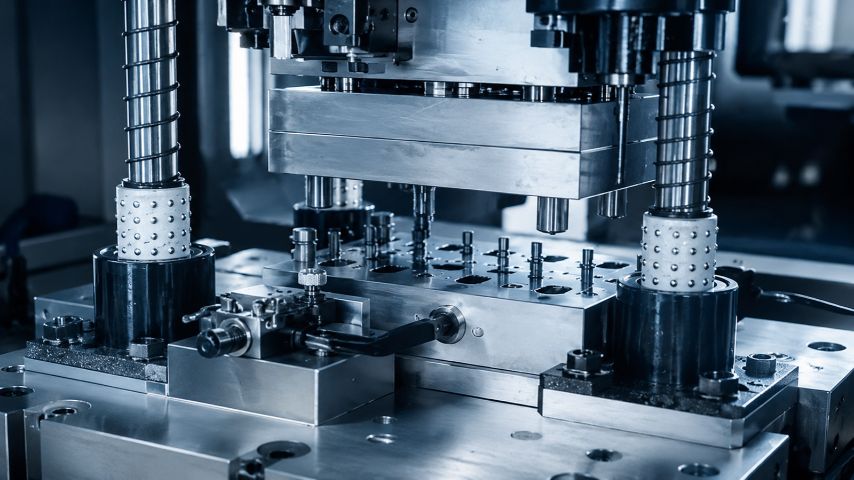
A drill jig positions a bushing or guide bar over the exact spot where a hole needs to be cut, so an operator working on a drill press or portable drill produces the same hole location on every part without marking it out each time. Locating fixtures do a related job for machining or welding operations; they hold the part against fixed datum points so the machine’s reference position matches the part’s actual geometry. Both types are built around the part’s drawing, with tolerances tight enough that the fixture itself doesn’t introduce error beyond what the process already allows.
These fixtures see the most use in repeat-batch work, where a buyer needs several hundred or several thousand identical parts and can’t afford operator-to-operator variation in how a hole or a feature lands. A drill jig built for a bracket, for instance, removes the need to mark and center-punch each piece by hand, cutting cycle time and removing a common source of hole-position error. Buyers supplying their own drawing with GD&T callouts, a dimensioning system that defines allowable position and form tolerance, get a jig built to match those callouts directly rather than a generic approximation.
Assembly and Inspection Fixtures
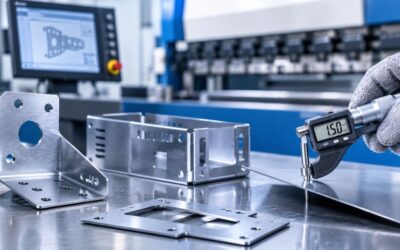
Assembly fixtures hold two or more components in the correct relative position while they’re welded, bonded, riveted, or bolted together. As a result, the finished assembly comes out square and within spec without an operator having to align it by eye. These are common in sheet-metal and multi-part builds, where small misalignment during assembly compounds into a part that doesn’t fit downstream. A fixture built for this purpose typically includes clamps, locating pins, and sometimes a toggle-clamp mechanism that an operator can engage and release quickly between cycles, keeping assembly fixtures practical even on moderate-volume runs.
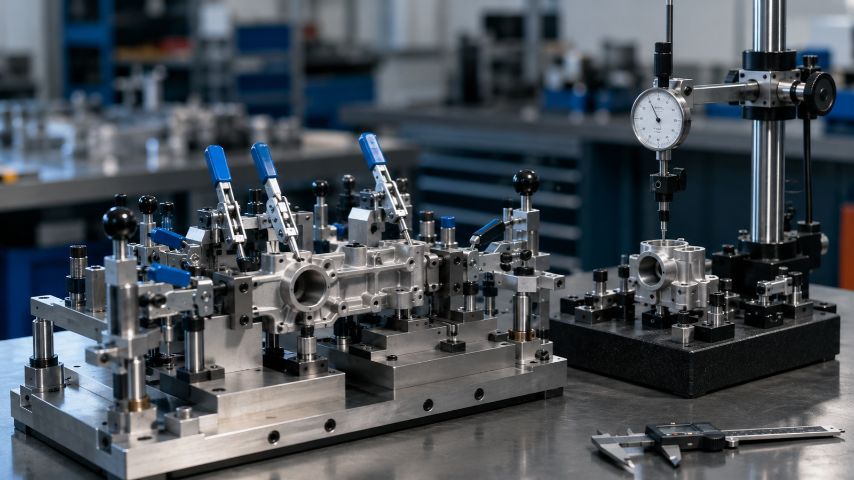
Inspection fixtures serve a different purpose: holding a finished part in a fixed, repeatable position so a gauge, dial indicator, or coordinate measuring arm checks the same points every time. This matters for buyers running their own incoming inspection, since a part that shifts slightly between measurements can produce a false reading on a feature that’s actually within tolerance. Attri Tech Machines builds inspection fixtures to match a buyer’s own quality-check routine where that routine is specified in advance, rather than assuming a generic measurement sequence will suit every part family.
How a Custom Fixture Moves From Drawing to Shop Floor
Building a fixture starts with the part it needs to hold, not a generic template. Attri Tech Machines follows a consistent sequence from the buyer’s drawing through design, material selection, build, and trial-fit, so a fixture doesn’t reach the shop floor until it’s checked against an actual sample part, not just the drawing on paper.
Design Review and Material Selection
The process starts with the buyer’s part drawing, including any critical dimensions, datum references, and the volume of parts expected to run through the fixture. A design engineer determines where the part needs to be located, how it should be clamped without distorting thin sections, and whether the fixture needs to index, rotate, or shift to expose different faces of the part in a single operation. This stage also flags anything in the drawing that’s ambiguous or missing, since a fixture built against an incomplete drawing usually needs rework once the real part shows up.
Material selection follows directly from how the fixture will be used. A fixture handling a few hundred parts a month in a clean assembly area can use mild steel or aluminum; one running thousands of cycles in a machining cell, where it takes repeated clamping and occasional chip contact, usually needs tool steel or a hardened wear plate at the contact points. Attri Tech Machines selects material based on expected cycle count and the operating environment the buyer describes, rather than defaulting to one material across every job, a detail covered further in the materials section below.
Build, Trial-Fit and Sign-Off
Once the design is approved, the fixture body is machined on the same CNC turning and VMC equipment used for production parts, which keeps locating surfaces and clamp faces within the same tolerance band the buyer expects from the parts themselves. Pins, bushings, and clamp components are turned or milled to fit, then assembled into the finished fixture. At this stage, the build follows the approved drawing closely enough that there’s little room for interpretation; any change from the original design gets flagged back to the buyer rather than made unilaterally on the shop floor.
Before a fixture is released to production, it’s trial-fitted with an actual sample part, or a first-article part if the component itself is new. This step checks that the part locates correctly, that clamping doesn’t distort it, and that the fixture holds its position through a few repeat cycles. Buyers who want to witness this step, or receive a trial-fit report before sign-off, can ask the team to confirm this before the production run starts.
Build a Custom Fixture or Jig With Attri Tech Machines
Every jig and fixture covered in this guide is designed, machined, and trial-fitted in-house at Attri Tech Machines’ Ghaziabad facility, so a buyer’s tooling moves from drawing to production floor without routing through a separate tool room. View Attri Tech Machines’ tool and die manufacturing capabilities to see how an inquiry typically proceeds.
Material Choices and Why They Affect Fixture Life
The material a fixture is built from determines how long it holds its tolerance under repeated use, and the right choice depends on cycle count, clamping force, and whether the fixture will see any abrasive contact. This section covers the trade-offs between common fixture materials and when a hardened wear surface is worth the added cost.
Tool Steel, Mild Steel and Aluminum Trade-Offs
Mild steel is the common default for fixture bodies; it machines easily, holds dimensions well under moderate use, and costs less than tool steel, making it a reasonable choice for fixtures expected to run a few hundred to a few thousand cycles in a controlled environment. Aluminum comes into play when the fixture needs to be lightweight, for instance, a fixture an operator lifts and repositions by hand several times a shift. However, it wears faster at high-friction contact points and isn’t the first choice where heavy clamping force is involved.
Tool steel costs more and takes longer to machine, but it holds tighter dimensions over a much higher cycle count and resists wear from repeated clamping, part insertion, and removal. Attri Tech Machines recommends tool steel for fixtures expected to run in continuous high-volume production, or anywhere the fixture’s locating surfaces see direct, repeated contact with the part’s edges. The decision isn’t purely about budget; a tool-steel fixture built for a short production run adds cost without a matching benefit, so expected volume genuinely drives the material call rather than defaulting to the toughest option available.
Hardening and Wear-Surface Treatment
Even a tool-steel fixture can wear at specific contact points- a locating pin, a clamp jaw, a bushing bore- faster than the rest of the body, especially in high-cycle production. Hardening treats just those surfaces to resist wear without hardening the entire fixture, which would make it brittle and harder to machine or repair later. This keeps the fixture’s critical dimensions stable over a longer service life while leaving the rest of the structure easier to adjust if the part design changes down the line.
Attri Tech Machines applies hardening or a wear-resistant insert selectively, based on where contact actually happens rather than across the whole fixture by default. A buyer running a fixture at high volume should ask directly whether the quoted build includes hardened wear points at the contact surfaces, since this detail affects both upfront cost and how often the fixture needs to be reworked or replaced later. This is a reasonable question to raise during the design-review stage covered earlier, before the fixture goes into build.
Turnaround Time: What In-House Building Actually Saves
Building tooling in-house, on the same shop floor as the parts it will hold, removes a step that otherwise adds real time to a production schedule. This looks at where that time typically goes when tooling is outsourced, and what turnaround a buyer can realistically expect when the fixture is built at Attri Tech Machines alongside the parts themselves.
Why Routing Tooling to a Third Party Adds Weeks
When a manufacturer doesn’t build its own tooling, a custom fixture has to be quoted, designed, and machined by a separate job shop, then shipped back and trial-fitted before production can start. Each handoff between the part manufacturer and the tooling shop adds communication lag, drawings have to be reviewed twice, questions about fit or clamping go through an intermediary, and any design change during trial-fit means another round trip. None of this is unusual in the industry; it’s simply a structural delay that comes from splitting part production and tooling production across two separate businesses.
Building tooling in-house removes most of that back-and-forth, because the same engineers who will run the part on the CNC turning or VMC equipment are involved in designing the fixture that holds it. A design question gets resolved on the same floor rather than through an email chain with a third-party tool room, and the trial fit happens on the actual machine the part will run on rather than a separate test setup. This doesn’t eliminate lead time; a fixture still has to be designed, machined, and checked, but it removes the shipping and coordination delay that a split arrangement adds.
Typical Lead Times for Jigs and Fixtures
Lead time for a custom jig or fixture at Attri Tech Machines depends mainly on complexity; a simple drill jig with one or two locating points takes less design and machining time than a multi-point assembly fixture with several clamps and an indexing mechanism. As a general pattern, simpler fixtures move from approved drawing to trial-fit faster than fixtures built around parts with tight GD&T callouts or unusual geometry, since those need more design-review time upfront to avoid rework after the build.
Exact lead times vary by current shop load and the specific fixture’s complexity, so buyers should request a firm timeline once the drawing and expected run volume are confirmed rather than relying on a general estimate. What stays consistent is the sequence: design review, material selection, build, trial-fit and sign-off, each of which a buyer can ask to see evidence of before the fixture is released to their production line. Requesting a written lead-time estimate at the quoting stage avoids surprises once a production schedule is already set around it.
Precision and Repeatability Requirements for Work-Holding Tooling
A fixture is only useful if it locates a part the same way every time, which means its dimensional accuracy must be tighter than the tolerance it’s meant to protect. This covers how locating tolerance on the fixture itself affects part consistency downstream, and how a fixture gets checked before it’s trusted with a production run.
Locating Tolerance and Its Effect on Part Consistency
A locating pin or datum surface on a fixture must hold its position within a tighter tolerance than the part feature it locates; otherwise, the fixture becomes the source of variation rather than the part or the machining process. If a part’s hole position needs to hold ±0.05 mm, for instance, the fixture’s locating pins generally need to hold a noticeably tighter tolerance than that, so that any drift comes from the machining process, which can be monitored and adjusted, rather than from the fixture quietly shifting that reference point on every cycle.
This is a common point buyers overlook when evaluating a fixture quote: a cheaper fixture built to a looser internal tolerance may look identical to a tighter one on paper, but produces visibly worse part-to-part consistency once it’s running at volume. Attri Tech Machines builds locating features to a tolerance appropriate to the part’s specification and flags during design review when a part’s tolerance is tight enough that the fixture needs correspondingly tighter machining and inspection before release.
Checking a Fixture Before It Goes Into Production
Before a new fixture goes into a production run, its critical locating and clamping surfaces are checked against the drawing using the same dimensional inspection tools used on finished parts: dial indicators, height gauges, or a coordinate measuring arm, depending on the feature being checked. This confirms the fixture itself is within tolerance before it’s ever used to hold a real part, rather than discovering a locating error only after a batch has already run through it and come out inconsistent.
See trial-fit sign-off above for how this is confirmed before release.
Not sure which tooling category your part needs? Mould inserts and dies shape material; fixtures hold formed parts. See Mould Inserts and Dies for that process.
When a Buyer Needs Custom Tooling Instead of Standard Work-Holding
Not every production run justifies a custom fixture; for very low volumes or simple, symmetrical parts, standard work-holding can be more cost-effective. This looks at the signals that point toward a custom build, and where a one-off or prototype run is better served by a simpler setup.
Signs a Standard Fixture Won’t Hold the Part
A part with an irregular profile, a thin wall that distorts under clamping pressure, or features on more than one face that need to be machined without re-fixturing the part are all signals that standard work-holding won’t hold tolerance consistently. Another common signal is a part that currently passes inspection only when an operator spends extra time adjusting its position by hand; that extra handling time usually signals the part needs a fixture built specifically around its geometry rather than a generic clamp adapted to fit.
Repeat-batch work is the other clear signal. If a buyer is running the same part number dozens or hundreds of times a month, the time saved per cycle by a fixture that loads correctly on the first try adds up quickly, even accounting for the fixture’s upfront cost. A buyer evaluating whether to request a custom fixture should look at current cycle time, current reject rate on positioning-related defects, and expected monthly volume; if those numbers show meaningful cost from inconsistent locating, a custom fixture is usually the better long-term choice.
Low-Volume Runs and One-Off Prototypes
For a true one-off part or a prototype run of a handful of pieces, a full custom fixture often isn’t worth the design and build time, since the part will be made so few times that manual setup, careful measurement, and operator attention cost less overall than engineering a dedicated fixture. In these cases, Attri Tech Machines typically uses adjustable or modular work-holding, set up carefully for the specific part rather than built from scratch, which keeps prototype costs reasonable while still holding the tolerance the drawing calls for.
The decision point usually comes once a prototype moves toward confirmed production volume; at that stage, it’s worth revisiting whether a custom fixture would now pay for itself. Buyers transitioning a part from prototype to a confirmed production run should raise the tooling question again at that point, since the fixture requirement that made sense at five pieces often doesn’t hold up once the same part needs to run at five hundred pieces a month with consistent cycle time.
Buyer Due Diligence: Documentation and Verification Before Committing a Fixture Build
Custom tooling is a cost a buyer commits to before seeing the fixture run in their own production environment, so it’s reasonable to ask for documentation before approving a build. A written quote should specify the fixture’s expected service life in cycles, the material and any hardening treatment included, and the lead time from approved drawing to trial-fit sign-off; each affects total cost of ownership, not just the upfront price.
A formal First Article Inspection report, trial-fit witness, or written material certification is worth confirming with Attri Tech Machines in advance, since adding inspection steps mid-project usually extends the timeline.
Where a fixture will be used for a safety-relevant or regulated application, buyers should also confirm independently whether their own industry requires third-party validation of the tooling itself, separate from validation of the parts it produces; this is a question for the buyer’s own quality team as much as for the tooling supplier.
Start Your Custom Tooling Inquiry
A fixture that locates a part correctly on the first try, every time, cuts rejects and keeps cycle time steady on a production line. Share a part drawing and expected run volume, and Attri Tech Machines will return a build timeline and material recommendation for your jigs, fixtures, or work-holding tooling requirements.
Attri Tech Machines Pvt. Ltd.
Address: Plot No. 10–11, Gopal Industrial Compound, Meerut Road Industrial Area, Ghaziabad – 201001, Uttar Pradesh, India
Phone: +91 92665 79700
Email: sales@attritechmachines.com
Website: www.attritechmachines.com
Frequently Asked Questions About Custom Tooling and Fixtures: Built In-House, Fast
How long does it take to get a custom fixture built?
Lead time depends on the fixture’s complexity and current shop load; see the Turnaround Time section above for how this is scoped. Request a firm timeline once your drawing and run volume are confirmed.
What’s the minimum order for a custom fixture or jig?
There’s no fixed minimum; a one-off can use adjustable work-holding instead of a dedicated build. See Low-Volume Runs above for when a custom fixture starts to pay off.
What materials are used for custom jigs and fixtures?
Mild steel, tool steel, and aluminum are common choices; selection depends on expected cycle count and clamping force (see Material Choices above). High-volume fixtures typically use hardened tool steel at contact points.
Can Attri Tech Machines build a fixture from our own design, not just our part drawing?
Yes. Buyers who already have a fixture design or concept can supply it directly, and Attri Tech Machines will review it against the part drawing before machining, flagging any fit or tolerance concerns before the build starts. Where no design exists yet, the team develops one from the part drawing and stated clamping or locating requirements as part of the standard build sequence.
Do custom fixtures get checked before they’re used in production?
Yes. Every fixture is trial-fitted against an actual sample or first-article part before release, checking that the part locates correctly and clamping doesn’t distort it. Buyers requiring a documented First Article Inspection report covering parts made on the new fixture can request one at the quoting stage, so inspection time is included in the project’s lead-time estimate rather than added later.
What’s the difference between a jig and a fixture?
A jig guides a cutting tool to a fixed location on the part, such as directing a drill bit to the correct hole position. A fixture holds the part itself in a known position so a machine or operator can work on it without re-measuring each time. Many production setups use both together, a jig for tool guidance and a fixture for part location.
Can an existing fixture be repaired or modified instead of building a new one?
In many cases, yes. Worn locating pins, clamp jaws, or wear plates on an existing fixture can often be replaced or re-machined rather than rebuilding the whole fixture, which is usually faster and lower cost. Attri Tech Machines can assess a worn fixture brought in for repair and recommend whether modification or a full rebuild makes more sense based on its condition.
Does a custom fixture come with a drawing or documentation for our own records?
Buyers can request a fixture drawing and a build record covering material, locating tolerance, and any hardening applied, for their own quality documentation or for use if the fixture ever needs to be reordered or repaired elsewhere. This should be specified at the quoting stage, since it’s not generated automatically unless requested.
What happens if the part design changes after a fixture has already been built?
A design change usually means the fixture needs to be reviewed and, depending on what changed, modified or rebuilt to match the new part geometry. Attri Tech Machines treats this as a new design-review step rather than assuming the existing fixture still fits, since even a small dimensional change on the part can shift where it needs to be located or clamped.
Is custom tooling worth it for a short production run?
It depends on volume and geometry, not a fixed rule; see Low-Volume Runs and One-Off Prototypes above for the specific trade-off.