Precision sheet-metal fabrication turns flat metal stock into formed, pressed, and punched components that hold specified tolerances across a production run. For a procurement buyer comparing CNC manufacturers in India, sheet-metal capability matters because it determines whether a supplier can move a part from flat blank to finished, deburred component without outsourcing the forming step.
What Precision Sheet-Metal Fabrication Involves
Sheet-metal fabrication is the process of cutting, punching, bending, and forming flat metal sheet into a finished component using press tooling. It covers everything from simple punched blanks to multi-bend enclosures, and it sits apart from machining because material is reshaped rather than removed.
What the Process Actually Covers
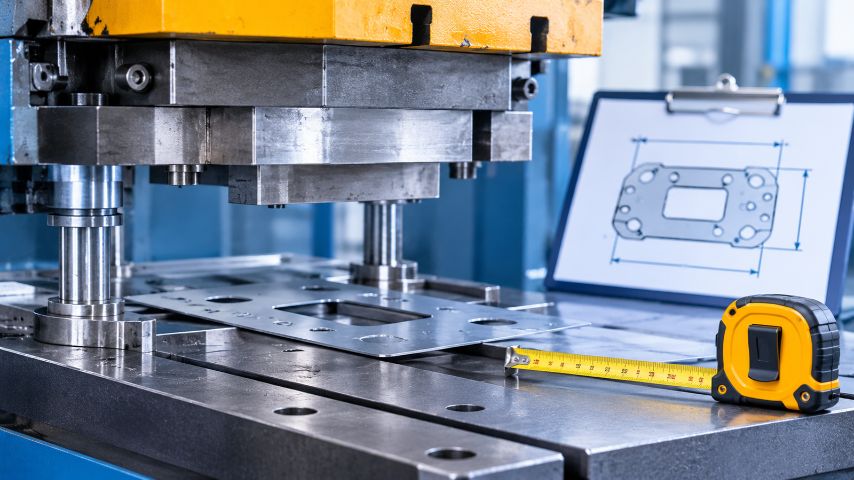
Sheet-metal fabrication starts with flat stock, typically mild steel, stainless steel, or aluminum sheet in a specified gauge, which is cut to a blank shape, then punched, pierced, or bent using die tooling mounted on a mechanical press. The press applies controlled tonnage to force the material through or around the tool, producing holes, flanges, embosses, or bend angles in a repeatable sequence. Unlike CNC turning or VMC milling, which remove material to reach a final shape, sheet-metal forming redistributes the material itself, which means tool design and press tonnage, not just program accuracy, determine how closely a finished part matches its drawing. Attri Tech Machines lists sheet-metal fabrication among its published manufacturing capabilities alongside its core CNC processes.
A general sheet-metal part can involve a single punch-and-bend operation or a sequence of six or more press strokes, depending on geometry. Buyers evaluating a supplier should ask how many separate operations a given drawing requires, since each added operation introduces a fresh opportunity for dimensional drift. A part with several bends in sequence needs the first bend held accurately before the second is formed, or the final profile shifts out of tolerance. This is a general industry consideration rather than a claim specific to any one factory, and it applies whether the forming happens on a 20-ton bench press or a larger production press.
How This Differs From Removal-Based Machining
Sheet-metal forming and CNC machining solve different problems, and conflating them leads buyers to request the wrong process for a part. CNC turning and VMC milling remove material from a solid blank to reach final dimensions, which suits parts needing internal features, tight bores, or complex 3D geometry. Sheet-metal forming instead bends and punches a thin, flat section into a shaped part, which suits brackets, panels, enclosures, and covers where wall thickness stays constant throughout. A buyer deciding between the two should first look at the part’s wall-thickness profile: constant-thickness formed shapes point toward pressing, while varying cross-sections point toward machining.
The two routes also behave differently in how they scale across a production run. Sheet-metal tooling is built once and then runs repeatedly, with each press stroke taking seconds, while machining cycles through material removal on each part. A buyer with a high-repetition, constant-thickness geometry generally finds pressing a more direct fit. In contrast, a buyer with varied, low-repetition geometry generally finds machining a more direct fit. This is a process-selection consideration rather than a claim about which route suits every buyer’s situation.
How Press Tonnage Shapes What a Supplier Can Produce
Press tonnage sets the practical ceiling on material thickness, part size, and forming complexity a sheet-metal supplier can handle in-house. This explains how 20-ton and 50-ton capability translates into real part constraints.
What 20-Ton and 50-Ton Capability Means in Practice
Press tonnage refers to the force a press can apply before the tool bottoms out or the material resists further deformation, and it’s typically rated as the maximum force the ram can exert at the bottom of its stroke. A 20-ton press suits lighter-gauge material and smaller blank sizes, fine blanking, piercing, and light bending on sheet up to roughly 2–3mm depending on material hardness.
A 50-ton press extends that range to thicker-gauge stock, larger blank areas, and bends that need more force to hold their angle without springback. Attri Tech Machines’ published inventory lists both tonnages, which, according to the company’s own material, lets general sheet-metal orders move between lighter and heavier gauge work without routing a job to an outside press shop.
Buyers should treat tonnage as a starting filter, not a full specification. Two parts needing the same tonnage can still behave differently depending on material; stainless steel work-hardens faster than mild steel under repeated bending, which can mean a part specified in steel needs a tooling adjustment when the buyer later switches to stainless for corrosion resistance. Requesting the supplier confirm tonnage against the specific material and gauge in the drawing, rather than assuming a press rated for one material handles any material at that thickness, avoids a mismatch discovered only after the first production run.
Matching Part Size to Press Bed and Stroke
Beyond raw tonnage, a press’s bed size and stroke length determine the maximum blank dimensions and bend depth a job can accommodate. A press rated at sufficient tonnage for a thick-gauge part may still be unsuitable if the bed is too small for the flat blank before forming, or if the stroke length can’t complete a deep-draw bend in one pass. This is a common point of confusion for buyers who specify tonnage correctly but overlook physical bed dimensions when comparing suppliers, since tonnage figures are quoted more prominently than bed size in most supplier literature.
For general, non-automotive, non-bracket sheet-metal parts, covers, panels, enclosures, mounting plates, and similar components, bed and stroke compatibility usually becomes relevant at larger part sizes or where a single bend needs to travel further than a standard stroke allows. A buyer with an oversized or deep-draw part should ask a prospective supplier directly whether the part fits within bed and stroke limits before tooling is cut, since die rework after the fact adds lead time that a short upfront confirmation call avoids entirely.
Get a Sheet-Metal Fabrication Quote Reviewed
Buyers with a drawing ready for general sheet-metal fabrication can request a quotation review from Attri Tech Machines’ engineering team before committing to tooling. Sharing the part drawing, material, gauge, and expected volume upfront helps the team confirm tooling feasibility before production.
Materials and Gauge Ranges Suited to Sheet-Metal Parts
Material choice and gauge thickness interact directly with press capability, finish quality, and part behavior. This section covers the materials most commonly specified for general sheet-metal work and how gauge selection affects forming behavior.
Common Materials for General Fabrication Work
Mild steel, stainless steel (typically grade 304 or 316), and aluminum make up most material requests for general sheet-metal parts. Mild steel forms predictably and suits enclosures, brackets, and covers that don’t face corrosive environments. Stainless steel work-hardens faster during forming than mild steel, but suits parts exposed to moisture, chemicals, or food-contact requirements. Aluminum forms easily and weighs less, which matters for parts destined for equipment where overall weight is a design constraint. However, it typically needs different tooling clearances than steel of the same gauge.
Material selection should happen before tooling is finalized, since switching materials after a die is cut can require adjustments to punch clearance and bend radius. A buyer unsure which material fits their application should share the end-use environment- indoor, outdoor, washdown, food-grade- with the supplier early, so gauge and material get specified together rather than gauge being fixed first and material substituted later without revisiting the tooling.
Gauge Thickness and Its Effect on Forming Behavior
Gauge thickness affects how a material responds to bending and piercing, and it drives decisions about bend radius, press tonnage, and tooling clearance. Thinner gauge material bends with a tighter minimum radius. Still, it needs more care at sharp internal corners to hold a clean edge, while thicker gauge material resists that issue but needs a larger bend radius and more press force to form accurately. A drawing specifying a bend radius tighter than the material’s minimum recommended radius for that gauge can produce an uneven bend line, which is a condition typically caught only once tooling is running rather than during design review.
Buyers sourcing general sheet-metal parts should confirm the minimum workable bend radius for their specified gauge and material combination before finalizing a drawing, rather than assuming any radius is achievable at any thickness. A supplier working from published machinery data, including press tonnage figures (company-reported), can usually flag an unworkable radius-to-gauge ratio during a quotation review rather than after tooling has already been committed to production.
Tolerances, Finishing and Quality Checks for Formed Parts
Tolerance expectations for pressed sheet-metal parts differ from machined-part tolerances, and finishing adds a further variable buyers should plan for before specifying a drawing.
What Tolerance Looks Like on a Pressed Part
Formed sheet-metal parts typically hold tolerances in the range of a few tenths of a millimeter on punched hole positions and slightly wider tolerances on bend angles, since springback, the material’s tendency to relax slightly after the press releases, varies by material, gauge, and bend geometry. General tolerance classes for formed and stamped steel parts are set out in reference standards such as DIN 6930-2, a widely used industry benchmark for linear and angular tolerance expectations on pressed parts; buyers can use this as an independent reference point when reviewing a supplier’s quoted tolerance range.
A drawing calling for machining-level tolerances on a formed feature usually signals a mismatch between process and specification, and a supplier reviewing the drawing should flag that during quoting rather than attempting to meet an unrealistic figure through repeated die adjustment.
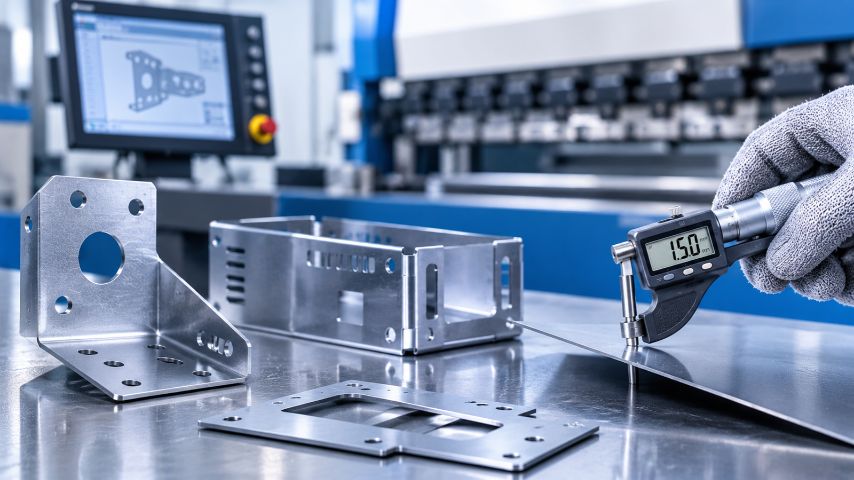
In-process checks during a pressed-part run typically involve periodic dimensional sampling against the drawing using calipers or a height gauge, with a final inspection before the batch is packed for dispatch. Buyers requiring a formal First Article Inspection report, a documented check of the first produced part against every drawing dimension, should request one explicitly ahead of a production run, since it is not always included as standard without being specified in the purchase order. Because dimensional drift or bend-angle inconsistency often only becomes visible across a full production batch rather than in a single sample, buyers should also ask how a prospective supplier monitors consistency across a production run, not just at first-article stage.
Finishing Options and Their Effect on Lead Time
Finishing adds a step after forming and before dispatch, and the finish specified affects both appearance and corrosion resistance. Common finishing routes for general sheet-metal parts include powder coating, zinc plating, passivation (for stainless steel), and simple deburring with no additional coating. Each route adds lead time on top of the forming and inspection schedule, since coating and plating are typically handled through a subcontracted finishing line rather than in-house equipment; buyers should factor this into overall delivery expectations rather than assuming the forming lead time alone covers the finished part.
Deburring, removing sharp edges left from punching and cutting, happens on essentially every pressed part regardless of whether further finishing is specified, since sharp edges affect both handling and assembly fit. Buyers should confirm with a prospective supplier whether deburring is included as standard or quoted separately, and whether the finishing subcontractor used for coating or plating is disclosed, since a buyer auditing their supply chain for a regulated end-use may need visibility into every stage a part passes through before it reaches their facility.
Typical Applications for General Sheet-Metal Components
General sheet-metal parts cover a wide range of end uses outside two specific, higher-volume categories that are covered separately. This outlines where general fabrication work typically applies.
Where General Fabrication Work Is Specified
General sheet-metal fabrication covers equipment enclosures, electrical panel covers, machine guards, mounting plates, ducting components, and similar parts used across industrial and OEM equipment manufacturing. These parts share a common thread: they’re specified by function and fit rather than by a narrow sector requirement, so the forming and finishing considerations covered in this post apply directly, without an added sector-specific layer. A buyer sourcing an enclosure for a control panel, for instance, cares primarily about dimensional fit, finish, and gauge, not about sector-specific pressed-part standards that apply elsewhere.
Two related categories sit outside this general scope and are covered separately. Automotive-specific pressed sheet-metal parts carry distinct sector requirements, and bracket-specific formed parts are treated as their own product family with dedicated geometry considerations. Buyers whose requirements fall into either category should review those parts separately rather than assuming general fabrication guidance fully covers sector-specific or bracket-specific tolerance expectations.
How Volume and Repeat Orders Affect Sourcing Decisions
General sheet-metal parts range from one-off prototype quantities to recurring production runs in the thousands, and the sourcing conversation differs meaningfully between the two. A one-off or low-volume order typically uses simpler tooling and accepts a slightly longer per-part cycle time, since tooling refinement isn’t a major factor at low quantities. A recurring production order justifies more refined die tooling that reduces cycle time and improves consistency run over run, which matters more as a production schedule extends over months rather than weeks.
Buyers planning a recurring order should discuss tooling ownership and maintenance terms with the supplier upfront, since die tooling typically has a service life measured in production strokes, and wear on punches or die edges can gradually affect hole size or bend accuracy if not maintained. Asking how a prospective supplier tracks tooling wear across repeat production runs is a reasonable sourcing question, and one that distinguishes a supplier set up for recurring sheet-metal work from one handling it as an occasional job.
Talk to Our Engineering Team Before You Tool Up
Ready to move forward? Contact Attri Tech Machines’ engineering team to begin a feasibility review of your sheet-metal drawing, or to ask any remaining questions about material, tonnage, or finish before committing to tooling.
Attri Tech Machines Pvt. Ltd.
Plot No. 10–11, Gopal Industrial Compound, Meerut Road Industrial Area, Ghaziabad – 201001, Uttar Pradesh, India
Phone: +91 92665 79700
Email: sales@attritechmachines.com
Website: www.attritechmachines.com
Frequently Asked Questions About Precision Sheet-Metal Parts: Built to Exact Spec
What’s the difference between sheet-metal fabrication and CNC machining?
Sheet-metal fabrication forms and punches flat stock into a shaped part without removing material, while CNC machining removes material from a solid blank to reach a final shape. Formed parts suit constant-thickness shapes like covers and brackets; machined parts suit features needing internal bores or complex 3D geometry that forming can’t produce accurately.
What materials can be used for pressed sheet-metal parts?
Mild steel, stainless steel (grades 304 and 316), and aluminum are the most commonly specified materials for general sheet-metal fabrication. Material choice depends on the end-use environment: mild steel for standard indoor enclosures, stainless steel for corrosive or washdown environments, and aluminum where reduced part weight matters to the overall equipment design.
What press tonnage is needed for a sheet-metal part?
Required tonnage depends on material, gauge thickness, and bend complexity, not part size alone. Lighter-gauge material and simple piercing operations typically suit a 20-ton press, while thicker gauge stock or bends needing more forming force typically require 50-ton capability. A supplier should confirm tonnage against the specific drawing rather than estimating from part dimensions alone.
How tight a tolerance can sheet-metal fabrication hold?
Pressed parts typically hold tolerances of a few tenths of a millimeter on punched features, with bend-angle tolerance varying by material and gauge due to springback. Tolerances tighter than this generally require a machining-based approach instead. Buyers should discuss achievable tolerance per feature with their supplier rather than specifying one blanket figure for the whole part.
Does a sheet-metal part need deburring after forming?
Yes, punching and cutting leave sharp edges on nearly every pressed part, and deburring is standard practice before a part is finished or dispatched. Buyers should confirm with their supplier whether deburring is included in the base quote or billed as a separate line item, since practice varies between suppliers.
How long does sheet-metal tooling take to set up for a new part?
Tooling lead time depends on part complexity and the number of forming operations required, and varies by supplier and current production load. Buyers should request a specific tooling and first-production lead-time estimate from the supplier for their exact drawing rather than relying on a generic industry figure, since die design complexity differs significantly between a simple punched blank and a multi-bend part.
Can sheet-metal parts be powder coated or plated?
Yes, powder coating, zinc plating, and passivation (for stainless steel) are common finishing options requested alongside sheet-metal fabrication. These finishing steps are typically handled through a subcontracted finishing line rather than in-house equipment, which adds lead time beyond the forming and inspection schedule. Buyers should confirm the finishing subcontractor and associated lead time directly with their supplier.
Does Attri Tech Machines export internationally?
Attri Tech Machines has not published independently verified export shipment history, so this should be treated as company-reported information rather than confirmed fact. Buyers with international sourcing requirements should request current export documentation, references, or shipment history directly from the company before finalizing a cross-border order.
What’s the typical lot size for a general sheet-metal order?
Lot size for general sheet-metal parts ranges from single-digit prototype quantities to recurring production runs, and the appropriate tooling approach shifts depending on where a buyer’s requirement falls on that range. A buyer should share their expected first-order quantity and repeat-order frequency with the supplier so tooling is sized to the actual production pattern rather than a one-size-fits-all approach.