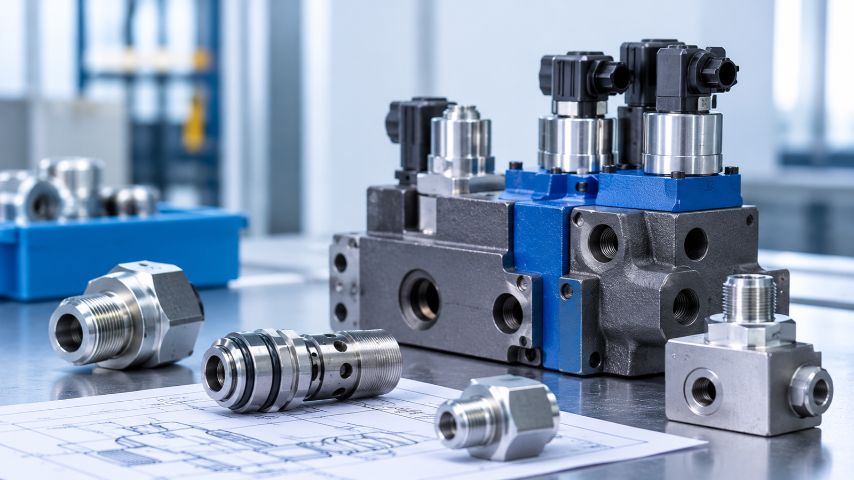
Hydraulic valve components, spools, sleeves, bodies, and fittings sit at the point where a system either holds pressure reliably or leaks, sticks, or fails under load. For a procurement buyer sourcing from a CNC manufacturer in India or elsewhere, the difference between a part that performs and one that doesn’t usually comes down to dimensional control, surface finish, and material selection. Attri Tech Machines Pvt. Ltd.: the details below reflect published capability, not implied guarantees.
What Hydraulic Valve Components Actually Do
Hydraulic valve components control the direction, pressure, and flow rate of fluid inside a hydraulic circuit. A spool shifts inside a sleeve or bore to open and close flow paths, while a valve body houses the ports that route fluid to actuators, cylinders, or motors. Because these parts operate under continuous pressure cycling, their function depends on tolerances and surface conditions that are easy to specify on a drawing and genuinely difficult to hold in volume production.
Spools, Sleeves and Bodies: The Core Component Types
A valve spool is a precision-turned shaft with machined lands and grooves that slide inside a matching sleeve or bore to direct fluid flow. The clearance between spool and sleeve is typically measured in microns, a unit equal to one-thousandth of a millimeter, because even a small increase in that gap lets fluid bypass the intended path, reducing system efficiency or causing erratic actuator movement. Sleeves are the stationary counterpart, bored and honed to match the spool’s outer diameter within a tight tolerance band.
Valve bodies are generally more geometrically complex, often requiring multiple machining operations to form internal ports, mounting faces, and seal grooves. Because a body usually needs features that a single-axis lathe cannot produce alone, many valve bodies move between CNC turning and milling operations before reaching final inspection. Buyers evaluating a supplier for valve bodies should ask specifically how the part moves between machines, since each transfer is an opportunity for alignment error that a spool-only production run wouldn’t face.
Why Fit and Finish Matter More Than Raw Dimensions
A hydraulic valve component can meet every dimension on a drawing and still fail in service if the surface finish is wrong. A spool with a slightly rough finish increases friction against the sleeve, which can cause the valve to stick partway through its travel, a failure mode that often shows up only after the system has been running under real load, not during a quick bench check. Surface finish specifications for hydraulic components are commonly expressed in Ra (roughness average, measured in micro-inches or micrometers) and should be stated explicitly on the purchase order, not assumed.
Fit is the second half of the equation. Spool-to-sleeve clearance that’s too tight causes binding as temperature changes expand the metal; clearance that’s too loose causes internal leakage and pressure loss. Buyers should request the supplier’s standard clearance range for the bore size in question and confirm whether spool and sleeve are matched as a set or manufactured to independent tolerance bands; the two approaches produce different consistency outcomes across a production batch.
Materials Commonly Used in Hydraulic Valve Components
Material choice affects corrosion resistance, wear life, and compatibility with the hydraulic fluid in use, and it’s one of the first specification decisions a buyer needs to lock down before quoting. The right material depends on operating pressure, fluid type, and the environment the finished assembly will run in, a detail that’s easy to overlook when comparing suppliers on specification sheets alone.
Steel, Stainless Steel and Brass: Matching Material to Application
Alloy and carbon steels are common for valve spools and sleeves in general industrial hydraulics because they offer good wear resistance and machinability compared with stainless alternatives. Many steel hydraulic components receive a hardening or surface treatment after machining to extend wear life at the spool-sleeve interface, since untreated steel can gall or wear unevenly under repeated cycling. Buyers specifying steel components should confirm whether hardening is included as part of the standard process or treated as a separate step, since this affects overall lead time.
Stainless steel is typically specified where the component will be exposed to moisture, washdown environments, or corrosive fluids, trading some machinability for corrosion resistance. Brass and bronze alloys appear in lower-pressure valve components and fittings where galling resistance and compatibility with certain fluids matter more than ultimate strength. None of these material choices is universally correct; the right one depends on the system’s pressure rating, duty cycle, and fluid chemistry, which is why a responsible supplier asks about application details before recommending a material rather than defaulting to whatever is already in stock.
When to Specify Material Certification
For hydraulic components used in regulated industries or safety-critical systems, buyers often need more than verbal confirmation of material grade; they need a material test certificate (MTC) tracing the raw-material batch back to its mill source. This document confirms chemical composition and mechanical properties. It is typically requested at the time of quoting, not after parts are delivered, since retroactively tracing material on a completed order is difficult or impossible.
Buyers should ask any prospective supplier, including Attri Tech Machines, whether MTCs are available for the specific material grade and batch used in their order, and should treat this as a standard procurement question rather than a special request. A supplier’s ability to produce a traceable MTC on request is a reasonable baseline expectation; a supplier’s ISO 9001:2015 certification status, where company-reported, is a separate data point (confirm specifics directly).
Specification Considerations Before You Order
Getting a hydraulic valve component drawing “mostly right” is a common and costly mistake, because small omissions in a drawing package tend to surface as disputes after parts are delivered rather than as quoting questions beforehand. A complete specification package reduces back-and-forth and protects both buyer and supplier.
What a Complete Drawing Package Should Include
A drawing package for a hydraulic valve component should specify the part’s critical dimensions with tolerances, the required surface finish (Ra value) on functional surfaces, the material grade, and any post-machining processes such as hardening, plating, or passivation. It should also state the fluid type and operating pressure range the component will see in service; even though these aren’t dimensions, a supplier who knows the application context can flag a specification mismatch before cutting metal rather than after.
Geometric dimensioning and tolerancing (GD&T) callouts, symbols that define form, orientation, and location tolerances beyond simple linear dimensions, are increasingly common on hydraulic component drawings because flatness, concentricity, and perpendicularity often matter more to function than basic diameter. Buyers working with a supplier unfamiliar with GD&T conventions should confirm early in the quoting process that the shop floor can interpret and hold these callouts, rather than discovering a gap after the first batch arrives.
Inspection and Documentation Buyers Should Expect
A first-time buyer should ask what inspection method confirms a critical dimension before parts ship; common methods include calipers and micrometers for straightforward dimensions, air gauging or bore gauges for internal diameters, and profile projectors or coordinate measuring machines (CMMs) for complex geometric features. The answer should be specific to the dimension in question, not a general assurance that “quality checks are performed.”
For a first production run or a new supplier relationship, requesting a First Article Inspection (FAI) report, a detailed dimensional report on the first parts produced, confirming conformance to the drawing before the rest of the batch runs, is a reasonable and common buyer request. Attri Tech Machines, in line with general industry practice for CNC-turned fluid-control parts, can provide this type of dimensional documentation on request; buyers should confirm the specific inspection equipment and report format before the production run begins, not after.

Talk to an Engineer Before You Finalize Your Drawing
A drawing reviewed before production starts catches specification gaps that are far harder to fix once machining is underway. Sharing your requirements early with a manufacturer experienced in fluid-control parts gives you a clearer picture of what’s achievable, what needs adjustment, and what documentation to expect at each stage of the order.
Common Failure Modes and What Causes Them
Understanding why hydraulic valve components fail in service helps a buyer ask sharper questions during sourcing, rather than discovering problems only after a system is already in the field. Most failures trace back to one of a small number of root causes.
Contamination, Wear and Dimensional Drift
Particulate contamination is one of the most common causes of hydraulic valve sticking and premature wear, since even microscopic debris trapped between a spool and sleeve can scratch the finish or jam the moving assembly. While contamination control is primarily a system-design and maintenance issue rather than a manufacturing one, a component manufactured with a rougher-than-specified surface finish is more likely to trap and hold debris in service, which is another reason surface-finish callouts deserve attention at the drawing stage rather than being treated as a minor detail.
Wear at the spool-sleeve interface accumulates gradually through normal operation, and the rate of wear is heavily influenced by the hardness and finish quality established during manufacturing. A component machined to the correct dimension but without the specified post-machining hardening treatment will typically wear faster than one that received it, even though both parts might pass initial dimensional inspection identically. This is a case where two “conforming” parts can have meaningfully different service lives.
Why Batch Consistency Matters More Than a Single Sample Part
A single sample part that performs well doesn’t guarantee an entire production batch will perform the same way, because tool wear, material batch variation, and machine calibration drift can gradually shift dimensions across a production run if they aren’t monitored. Buyers who approve a first article sample should ask how the supplier controls for this drift across the full order quantity, not just at the start of the run.
In-process dimensional checks at intervals throughout a production run, rather than inspection only at the beginning and end, are a reasonable way to catch drift before it affects a large portion of the batch. Buyers ordering hydraulic valve components in meaningful volume should ask a prospective supplier how frequently in-process checks occur during a run of the size they’re planning, since the answer reveals how seriously a shop treats consistency versus simply hitting a sample part.
Lead Times and Order Planning
Lead time varies by part and order, not a fixed figure — here’s what drives it. A simple spool and a multi-feature valve body rarely sit on the same timeline, and material sourcing can add or remove weeks depending on what’s already in stock. Buyers planning a launch date, a production line changeover, or a spares order should treat lead time as a range tied to their specific drawing, not a number quoted before the supplier has seen it.
What Affects Lead Time on a Hydraulic Component Order
A simple spool with standard material and no special post-processing can often move through CNC turning faster than a multi-feature valve body requiring turning, milling, and a secondary hardening step, since each additional operation adds both processing time and a queue wait between machine stations. Buyers should ask for a lead time estimate specific to their actual part geometry and finishing requirements, rather than relying on a generic “typical lead time” figure that may not reflect their component’s complexity.
Material availability is a frequently underestimated factor. A standard steel grade already stocked by the supplier moves faster than a specialty stainless alloy that needs to be ordered from a mill or distributor, and this sourcing step can add meaningful time to an otherwise straightforward order. Buyers working to a hard deadline should ask explicitly whether the specified material is in stock or needs procurement before confirming a purchase order against that date.
Planning for Reorders and Spare Parts
Hydraulic systems in the field often need replacement components years after the original order, which makes dimensional record-keeping genuinely important; a supplier who retains drawings, tooling specifications, and material records from the original run can typically reproduce a matching part faster and with less risk of dimensional mismatch than one quoting a reorder from scratch. Buyers should ask whether a supplier retains this documentation and for how long, particularly for components expected to need spares support over a multi-year equipment life.
For buyers anticipating variable demand, a larger initial order followed by smaller reorders as spares, production-volume flexibility is worth raising directly with the supplier at quoting time.
Comparing Suppliers for Hydraulic Valve Components
Buyers comparing multiple CNC manufacturers for hydraulic valve components are typically weighing dimensional capability, documentation practices, and communication quality against each other, and none of these can be judged from a specification sheet alone.
Questions Worth Asking Before Requesting a Quote
A buyer evaluating a new supplier for hydraulic valve components should ask what CNC turning equipment produces the part, what in-process and final inspection methods apply to the critical dimensions, and whether material test certificates and First Article Inspection reports are available on request. These questions surface more useful information than asking for a generic capability statement, because the answers are specific and checkable.
It’s also worth asking directly about a supplier’s experience with hydraulic components specifically, as distinct from general CNC machining capability; a shop that primarily produces non-fluid-control parts may not have the same instinctive attention to surface finish and clearance control that a shop with dedicated hydraulic component experience brings to a quote. Attri Tech Machines manufactures CNC-turned fluid-control parts as part of its published product range (confirm current capacity and lead time directly).
Red Flags That Warrant a Closer Look
A supplier response that doesn’t ask any clarifying questions about fluid type, operating pressure, or finish requirements is a mild warning sign, since a supplier experienced with hydraulic components usually has follow-up questions before taking on a job seriously. Similarly, a supplier unwilling to commit to a specific inspection method or unable to describe how they’d verify a critical clearance dimension may not have the equipment or process discipline the application needs.
Buyers should also be cautious of unusually fast lead-time promises on complex valve bodies without an explanation of how that timeline is achieved; a legitimately fast lead time is usually explainable by stocked material, available machine capacity, or simpler part geometry, not vague assurances. Where a claim about certification, export experience, or capacity seems important to the sourcing decision, it’s reasonable to ask the supplier to confirm it directly and in writing rather than relying on marketing copy alone.
How Attri Tech Machines Approaches Hydraulic Valve Component Orders
Attri Tech Machines manufactures hydraulic valve components as CNC-turned fluid-control parts from its facility in Ghaziabad, Uttar Pradesh. As with any supplier evaluation, buyers should treat the description below as a starting point for direct confirmation, not a substitute.
Process Fit for Spools, Sleeves and Related Components
CNC turning is the underlying process for most hydraulic valve spool and sleeve geometries, producing the rotational symmetry and dimensional consistency these components require (confirm specifics directly). See Attri Tech Machines’ CNC turning capabilities for full process details. Components requiring additional milled features, such as certain valve bodies, typically move between turning and milling operations within the same facility rather than being routed to a separate job shop, which can reduce handling risk and simplify scheduling for the buyer.
Buyers with a drawing ready for review should expect an initial response covering estimated lead time, material options, and any clarifying questions about finish or clearance requirements, rather than a generic response with no engineering input. A generic reply with no engineering questions attached is worth a second look.
What to Confirm Directly Before Placing an Order
Buyers should confirm current machine availability, exact lead time for their specific part and quantity, and documentation options such as MTCs and FAI reports directly with Attri Tech Machines’ sales team before finalizing a purchase order; none of these details should be assumed from general capability statements, including the ones in this guide. Published machinery inventory and facility details are company-reported and provide useful context for a sourcing conversation. Still, they are not a substitute for a written quote tied to the buyer’s specific drawing.
Reviewing the company’s product catalog on their website gives buyers a starting reference point before that direct conversation.
Packaging, Delivery and Post-Order Support
What happens after a hydraulic valve component passes inspection matters almost as much as the machining itself, since damage in transit or inadequate corrosion protection during storage can undo precise manufacturing before a part ever reaches an assembly line.
Protecting Precision Parts in Transit
Hydraulic valve components with tight clearances and fine surface finishes need packaging that prevents both physical impact damage and corrosion during shipping, particularly for bare steel parts traveling through humid climates or long transit times. Rust-preventive oils or vapor-corrosion-inhibitor packaging are common approaches for unprotected steel components, while plated or stainless parts have somewhat more tolerance for storage conditions but still benefit from individual protective wrapping to prevent surface scratches from parts contacting each other.
Buyers receiving a first shipment from a new supplier should inspect packaging condition on arrival and flag any damage immediately, since this feedback helps adjust packaging on future orders and may also affect warranty or replacement conversations if a part arrives compromised. Asking a prospective supplier how they package hydraulic components specifically, rather than assuming standard industrial packaging applies uniformly, is a reasonable question to raise during the quoting stage.
What to Do If a Received Part Doesn’t Meet Specification
If a received hydraulic valve component appears out of tolerance, has a finish that doesn’t match the specification, or otherwise seems inconsistent with the drawing, buyers should document the issue with measurements and photographs before raising it with the supplier, since specific evidence resolves disputes faster than a general complaint. Requesting the inspection report tied to that specific batch, if one was generated, helps establish whether the issue originated in manufacturing or occurred after the part left the factory.
A supplier’s willingness to discuss a nonconformance directly and work through root cause, rather than simply offering a replacement without explanation, is a reasonable indicator of process maturity worth factoring into future sourcing decisions.
When a Hydraulic Component Isn’t the Right Fit
Not every fluid-control application calls for a precision CNC-turned valve component, and recognizing this early avoids over-specifying a part beyond what the system actually needs. Low-pressure, low-cycle applications sometimes function adequately with standard off-the-shelf fittings rather than custom-machined spools and sleeves, and a buyer should weigh that option against the actual performance requirement rather than defaulting to custom machining out of habit.
Conversely, high-pressure or high-cycle systems, or applications with unusual fluid chemistry, often need tighter tolerances or specialized materials than a general-purpose catalog component can offer; in these cases, custom CNC-turned components are typically the more reliable choice. A conversation with a knowledgeable supplier before finalizing a design can clarify which category a given application falls into, and it’s worth raising this question even before a formal quote request, since it can change the entire sourcing approach.
Connect With Attri Tech Machines
Send your drawing and specification details for a review covering lead time, tolerances, and documentation options. Whether you’re sourcing a single spool or planning a recurring order, Attri Tech Machines’ engineering team can confirm what’s achievable before you commit to a purchase order.
Attri Tech Machines Pvt. Ltd.
Plot No. 10–11, Gopal Industrial Compound, Meerut Road Industrial Area, Ghaziabad – 201001, Uttar Pradesh, India
Phone: +91 92665 79700
Email: sales@attritechmachines.com
Website: www.attritechmachines.com
Frequently Asked Questions About Hydraulic Valve Components: The Buyer’s Survival Guide
What materials are used for hydraulic valve components?
Material choice depends on operating pressure, fluid type, and corrosion exposure. Carbon and alloy steels, often hardened after machining, are the common choice for general industrial spools and sleeves; stainless steel is used where moisture or corrosive fluid exposure is a concern, and brass or bronze appears in lower-pressure fittings. Buyers should specify the application’s pressure and fluid chemistry before quoting so the supplier can recommend the right grade.
What tolerance is typical for a hydraulic valve spool?
Tolerances for hydraulic valve spools are commonly held in the single-digit-micron range for critical diameters, since even a small increase in spool-to-sleeve clearance can cause internal leakage or erratic valve movement. The exact tolerance depends on the bore size and application pressure, so buyers should confirm the specific tolerance band a prospective manufacturer can hold for their part geometry rather than assuming a universal figure applies.
How long does it take to manufacture hydraulic valve components?
Lead time depends on part complexity, material availability, and order quantity, and can range from roughly one to several weeks depending on whether the part requires only turning or also milling and secondary hardening. A simple spool in stocked material typically moves faster than a multi-feature valve body in a specialty alloy. Buyers should request a lead time estimate tied to their specific drawing rather than relying on a generic industry figure.
What is the minimum order quantity for custom CNC parts?
Minimum order quantities for custom CNC-machined parts, including hydraulic valve components, vary by manufacturer and typically depend on part complexity and tooling setup cost rather than a fixed universal number. Some shops accommodate prototype or low-volume orders of a handful of pieces, while others set a higher minimum to offset setup time. Buyers should confirm the specific minimum with a prospective supplier for their exact part before quoting.
What inspection methods confirm a hydraulic valve component meets specification?
Common inspection methods include calipers and micrometers for straightforward linear dimensions, air gauging or bore gauges for internal diameters like spool-sleeve clearances, and coordinate measuring machines or profile projectors for complex geometric features. The appropriate method depends on which dimension is critical to function. Buyers should ask which method applies to their part’s specific critical dimensions before production begins.
Can hydraulic valve components be reordered years later with matching dimensions?
Reordering matching components years later is possible when the original supplier retains drawings, tooling specifications, and material records from the initial production run, reducing the risk of dimensional mismatch on a reorder. Buyers planning for long-term spares support should confirm with their supplier how long such documentation is retained and whether it covers the specific material batch and tooling used originally.
Does Attri Tech Machines export internationally?
Attri Tech Machines has not had independently verified export shipment history confirmed for this guide; any export activity would need to be confirmed directly with the company rather than assumed from general marketing material. Buyers requiring export documentation, shipping references, or import-compliance confirmation for their country should request this information directly from Attri Tech Machines’ sales team before placing an international order.
What’s the difference between a valve spool and a valve sleeve?
A valve spool is the moving component that slides within a bore to open and close fluid flow paths, while a sleeve is the stationary bore liner the spool moves inside, machined and honed to a matching tolerance. Some valve designs use the main valve body as the bore directly without a separate sleeve. The clearance between spool and sleeve, or spool and body, is the critical dimension controlling leakage and valve response.
Should I request a material test certificate for hydraulic valve components?
Requesting a material test certificate (MTC) is a reasonable standard practice, particularly for components going into pressure-critical or safety-related systems, since it traces the material batch back to its mill source and confirms chemical composition and mechanical properties. Request this at the quoting stage rather than after parts are delivered, since retroactively tracing material on a completed order is often not possible.